
What Is the PPWR? A Simple Guide for Shopify Merchants
The PPWR is an EU regulation that establishes a harmonised framework for packaging and packaging waste, covering areas including packaging sustainability, recyclability, reuse, waste prevention, labelling, and producer responsibility.
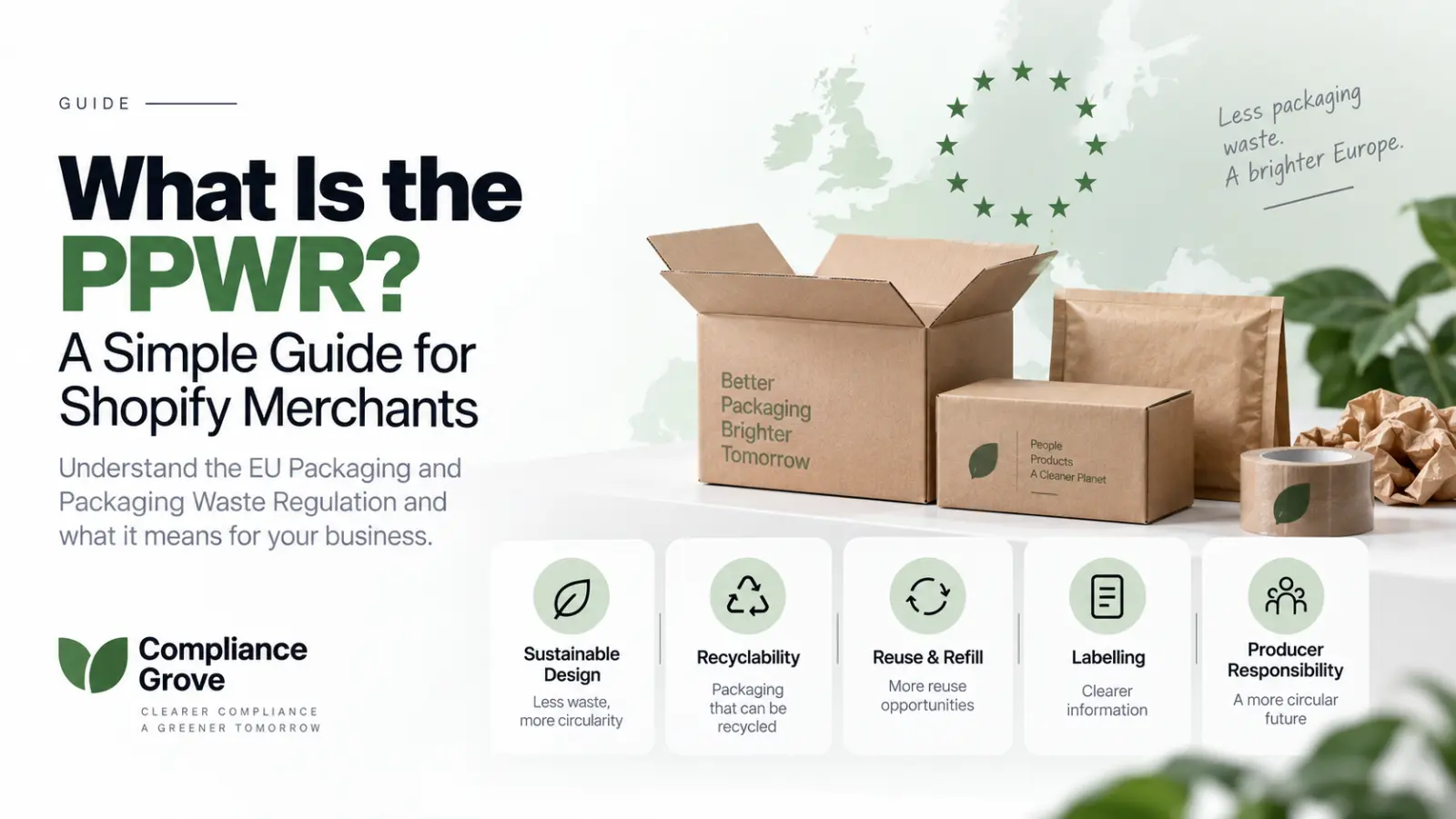
What Is the PPWR? A Simple Guide for Shopify Merchants
If you sell products in Europe, you may have heard a new acronym appearing alongside EPR: PPWR.
PPWR stands for the Packaging and Packaging Waste Regulation.
It is Regulation (EU) 2025/40, an EU regulation designed to create a more harmonised framework for packaging and packaging waste across the European Union.
For Shopify merchants, PPWR is important because packaging is no longer something that can be treated as an afterthought. The regulation covers a broad range of packaging-related topics, including packaging design, recyclability, reuse, waste prevention, labelling, and producer responsibility.
This guide explains what PPWR is, what it covers, and what Shopify merchants should understand about it.
Important: This article provides general educational information and is not legal advice. The requirements that apply to a particular business can depend on its products, packaging, role in the supply chain, and the markets where it operates.
What Does PPWR Stand For?
PPWR stands for Packaging and Packaging Waste Regulation.
The regulation is formally known as Regulation (EU) 2025/40 on packaging and packaging waste.
It establishes a common EU framework for packaging and packaging waste and replaces the previous EU Packaging and Packaging Waste Directive framework from the date specified in the regulation.
The regulation covers the packaging lifecycle rather than focusing only on what happens after packaging becomes waste.
In simple terms:
PPWR is about how packaging is designed, placed on the market, used, managed, and ultimately handled as waste.
When Does the PPWR Apply?
The PPWR entered into force on 11 February 2025 and applies from 12 August 2026.
That means PPWR is now part of the EU regulatory landscape for businesses placing relevant packaging on the European market.
However, not every requirement starts at exactly the same time.
The regulation contains different dates and transition periods for particular provisions, and additional implementing or delegated measures can provide further detail.
For that reason, merchants should avoid treating "PPWR compliance" as one single deadline.
Why Was the PPWR Introduced?
The EU has had packaging rules for many years, but packaging requirements have also developed differently across Member States.
The PPWR is intended to create a more harmonised framework across the EU while addressing packaging waste and the environmental impacts associated with packaging.
The European Commission identifies several broad objectives, including:
- Reducing packaging waste
- Improving the functioning of the EU internal market
- Promoting more circular use of materials
- Improving packaging recyclability
- Supporting reuse and refill
- Reducing unnecessary packaging
- Providing more harmonised packaging rules across the EU
The regulation therefore goes beyond simply asking businesses to report how much packaging they use.
What Does the PPWR Cover?
The PPWR covers a wide range of packaging-related topics.
Some of the major areas include:
Packaging Design
The regulation introduces requirements relating to how packaging is designed and what characteristics packaging needs to have.
Recyclability
Packaging is subject to requirements concerning its ability to be recycled.
The regulation establishes requirements and timelines intended to improve the recyclability of packaging placed on the EU market.
Recycled Content
Certain requirements relate to the use of recycled content, particularly for plastic packaging.
Reuse and Refill
The regulation introduces measures intended to increase reuse and refill systems in certain areas.
Packaging Waste Prevention
The PPWR aims to reduce unnecessary packaging and packaging waste.
Labelling and Information
The regulation introduces harmonised approaches to certain packaging information and labelling requirements.
Extended Producer Responsibility
The PPWR also contains provisions related to Extended Producer Responsibility and packaging waste management.
PPWR Is Broader Than EPR
One of the easiest ways to understand PPWR is to compare it with EPR.
EPR focuses on producer responsibility for products or packaging when they reach the waste stage.
PPWR is broader.
It covers areas across the packaging lifecycle, including:
| EPR | PPWR |
|---|---|
| Producer responsibility | Packaging lifecycle |
| Waste-management responsibilities | Packaging design |
| Registration and reporting can apply | Recyclability requirements |
| Producer contributions can apply | Reuse and refill |
| Often involves national systems | Waste prevention |
| Packaging waste focus | Labelling and information |
This means that being registered for an applicable EPR scheme does not automatically mean that every PPWR requirement has been addressed.
They are connected, but they are not the same thing.
What Does PPWR Mean for Shopify Merchants?
For ecommerce merchants, one of the most important changes is the need to understand packaging at a more detailed level.
A Shopify product may involve several packaging components.
For example:
- Product container
- Product box
- Shipping box
- Paper filling
- Plastic protective material
- Labels
- Tape
Instead of thinking about packaging as simply "the box," merchants need a clearer picture of the packaging associated with their products.
This makes packaging data increasingly important.
Why Packaging Data Matters
You cannot manage packaging requirements effectively if you do not know what packaging you are using.
A useful packaging record may include information such as:
| Information | Example |
|---|---|
| Product | Product A |
| Packaging component | Product box |
| Material | Cardboard |
| Weight | 80 g |
| Packaging type | Sales packaging |
| Recyclability information | Applicable assessment |
| Market | France |
The exact information needed will depend on the applicable requirement.
But building a structured packaging data process gives merchants a better foundation for understanding their obligations.
PPWR and Packaging Materials
The PPWR applies to packaging regardless of whether the packaging is made from:
- Paper
- Cardboard
- Plastic
- Glass
- Metal
- Wood
- Composite materials
- Other packaging materials
Different requirements can apply depending on the material and type of packaging.
For example, the regulation contains specific provisions concerning recycled plastic content and recyclability.
This is why simply recording that a product "has packaging" is not enough for a detailed compliance process.
Merchants should understand the components and materials that make up their packaging.
PPWR and Packaging Waste
A major objective of the regulation is to reduce packaging waste.
This includes addressing packaging that is unnecessary, excessive, difficult to recycle, or otherwise problematic within the packaging lifecycle.
For ecommerce merchants, this can make packaging design an operational consideration rather than purely a branding decision.
Questions worth asking include:
- Is the packaging necessary?
- Is the packaging appropriately sized?
- What materials are being used?
- Can the packaging be recycled?
- Could the packaging use recycled material where applicable?
- Could the packaging be reused or refilled where relevant?
- What information needs to be provided to consumers?
The exact requirements depend on the type of packaging and the relevant PPWR provisions.
What About Packaging Size and Empty Space?
Ecommerce orders can sometimes contain products inside boxes that are considerably larger than the products themselves.
The PPWR introduces measures addressing unnecessary packaging and empty space in certain packaging formats and applications.
This is particularly relevant to ecommerce because shipping packaging often needs to balance:
- Product protection
- Shipping efficiency
- Material use
- Customer experience
- Packaging waste
Merchants should therefore keep an eye on the specific PPWR requirements and implementation timelines that apply to their packaging.
PPWR and Recyclability
Recyclability is one of the major themes of the PPWR.
The regulation establishes requirements intended to ensure packaging placed on the EU market can meet defined recyclability criteria.
The regulation also establishes different timelines and requirements as the framework develops.
For merchants, this means packaging choices may increasingly need to be evaluated not only from a cost and branding perspective, but also from a compliance perspective.
PPWR and Reuse
The PPWR also promotes reuse and refill in areas where the regulation establishes applicable targets or requirements.
Reuse can involve packaging that is designed to be used multiple times rather than discarded after a single use.
This can affect certain business models and packaging formats differently.
Not every ecommerce merchant will face the same reuse requirements, so businesses should identify which provisions apply to their particular packaging and operations.
PPWR and Labelling
The regulation also introduces more harmonised approaches to packaging labelling and information.
The objective is to make certain packaging information easier to understand and more consistent across the EU.
For ecommerce businesses, this means packaging information should be treated as part of the compliance data associated with a product.
A packaging record can therefore eventually involve more than:
Material + Weight
It may also need to connect to relevant information about:
Material + Weight + Packaging Type + Market + Applicable Requirements + Labelling
The exact information required depends on the relevant PPWR provisions and implementation measures.
Does PPWR Replace EPR?
No.
PPWR does not simply replace EPR.
Instead, the PPWR establishes a broader packaging framework that includes provisions concerning Extended Producer Responsibility.
EPR remains an important part of packaging compliance, while PPWR introduces additional requirements relating to packaging itself.
A Shopify merchant should therefore think about compliance as several connected areas:
Packaging data → EPR → Reporting → Packaging requirements → PPWR readiness
What Should Shopify Merchants Do Now?
If you sell packaged products in Europe, there are several practical steps you can take.
1. Build a Packaging Inventory
Identify the packaging components associated with your products.
2. Record Materials
Document what each packaging component is made from.
3. Record Packaging Weight
Keep accurate weight information for relevant packaging components.
4. Connect Packaging to Products
Map packaging information to the Shopify products or SKUs that use it.
5. Identify Your Markets
Understand which European countries you sell into and where your products are being made available.
6. Review EPR Requirements
Check which EPR requirements and registration systems apply to your business.
7. Review PPWR Requirements
Identify which PPWR provisions are relevant to your products and packaging.
8. Keep Your Data Updated
Update your packaging records when you:
- Launch new products
- Change packaging suppliers
- Change packaging materials
- Change package sizes
- Introduce new packaging components
- Expand into new markets
A Simple Example
Imagine a Shopify merchant selling coffee products across Europe.
A single order could contain:
- A cardboard shipping box
- Paper protective material
- A printed cardboard product box
- A plastic inner pouch
- A product label
From an ecommerce perspective, this is simply one order.
From a packaging compliance perspective, it is several packaging components made from different materials.
A structured approach would look like:
Product → Packaging components → Materials → Weight → Market → Requirements
This gives the merchant a much clearer picture of the packaging associated with their products.
Common PPWR Mistakes to Avoid
Treating PPWR as Just Another EPR Registration
PPWR covers a much broader range of packaging requirements than EPR registration alone.
Waiting Until a Deadline
Some PPWR requirements have specific future application dates and transition periods.
Waiting until a deadline can make it harder to collect the necessary packaging information.
Not Knowing Your Packaging Materials
If you do not have accurate packaging information, it becomes harder to assess which requirements may apply.
Treating Every Package the Same
Different packaging formats and materials can be subject to different provisions.
Ignoring Product-Level Packaging Data
As your product catalogue grows, packaging information can become difficult to manage without a structured system.
How PackPilot EPR Helps
PackPilot EPR helps Shopify merchants organize packaging compliance information connected to their products.
You can use it to manage information such as:
- Products and SKUs
- Packaging components
- Packaging materials
- Packaging weights
- Recyclability information
- Country-specific compliance information
- EPR-related information
- Reporting-related data
The goal is to give merchants a structured place to manage the packaging information they need as European packaging requirements evolve.
PPWR Readiness Checklist
If you sell packaged products in Europe, ask yourself:
- Do I know all the packaging components used with my products?
- Do I know what materials they contain?
- Do I have accurate packaging weights?
- Have I mapped packaging to my products or SKUs?
- Do I know which European markets I sell into?
- Have I reviewed applicable EPR requirements?
- Have I reviewed the PPWR requirements relevant to my packaging?
- Do I have a process for maintaining packaging data?
- Can I update packaging information when products change?
- Do I have a process for monitoring new implementation guidance?
The Bottom Line
The PPWR is a broad EU regulation covering packaging and packaging waste across the packaging lifecycle.
For Shopify merchants, it means packaging deserves more attention than simply choosing a box and shipping a product.
The practical starting point is structured packaging data.
Know what packaging you use.
Know what it is made from.
Know how much you use.
Know which products use it.
Know where those products are placed on the market.
Then use that information to understand the EPR and PPWR requirements that apply to your business.
As the PPWR framework continues to develop through implementing and delegated measures, keeping your packaging information organized can make it easier to respond to changing requirements.
Official Resources
For the latest PPWR information, consult official EU sources:
- European Commission — Packaging & Packaging Waste Regulation
- European Commission — PPWR FAQ
- European Commission — New EU Packaging Rules
- EUR-Lex — Regulation (EU) 2025/40
- EUR-Lex — Commission Guidance on Regulation (EU) 2025/40
Regulatory requirements can vary according to your business model, products, packaging, role in the supply chain and target markets. Always verify the requirements applicable to your specific situation.
PackPilot EPR helps with this.
Simplify EPR compliance and manage packaging data across Europe.
Stay up to date
Get new country compliance profiles and guides in your inbox.
Related Posts
PPWR
EU Packaging Compliance Explained: EPR, PPWR & What Merchants Need to Know
EU packaging compliance can be confusing for ecommerce merchants. Learn how EPR and PPWR work, what they mean for Shopif...