
Does My Shopify Store Need EPR Registration in Europe?
Whether a Shopify merchant needs EPR registration depends on factors such as the products and packaging they place on the market, their role in the supply chain, and the European countries where they operate.
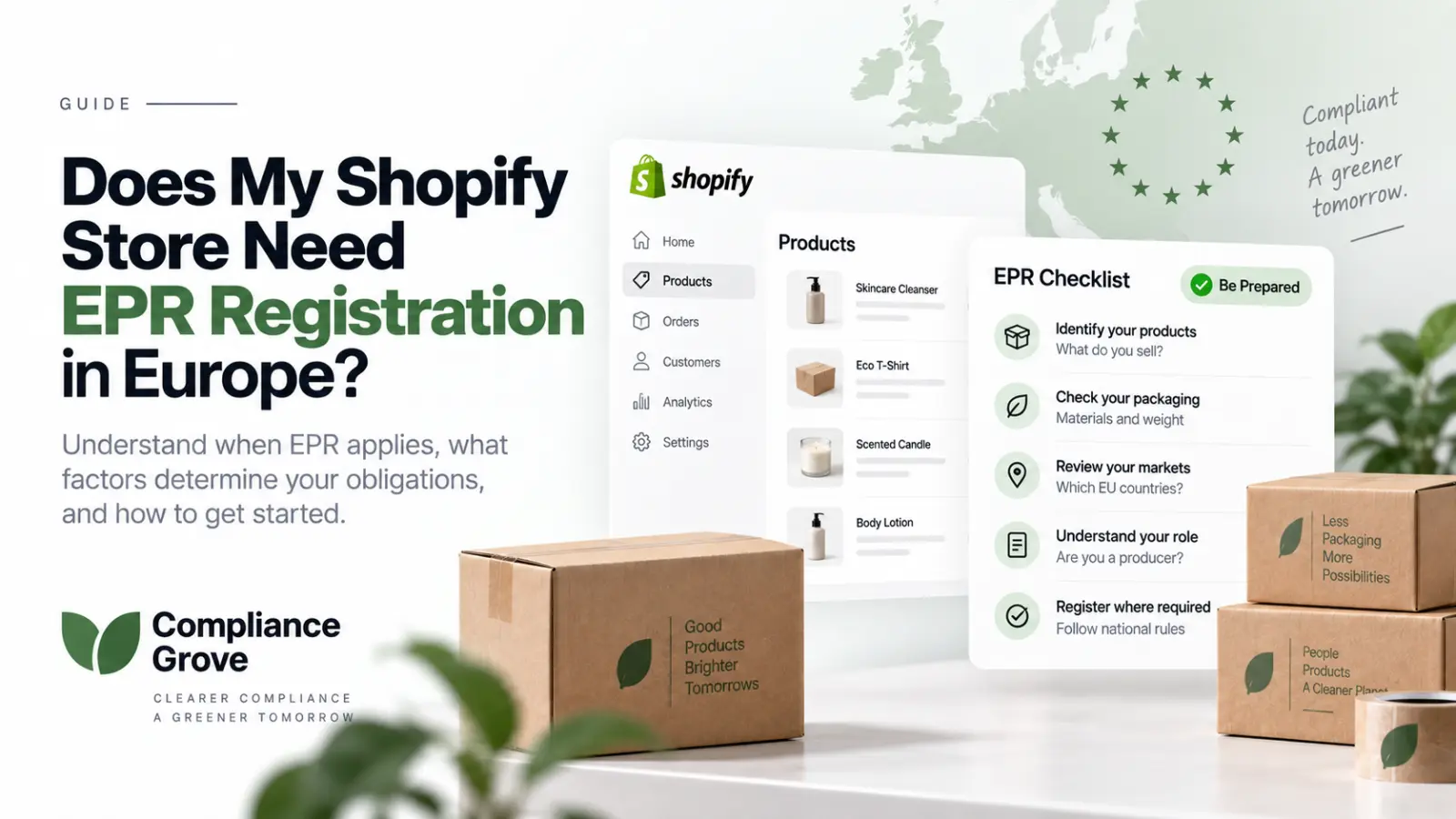
Does My Shopify Store Need EPR Registration in Europe?
Selling products to customers in Europe does not automatically mean that every Shopify merchant has exactly the same EPR obligations.
Whether you need to register, where you need to register, and what you need to report can depend on several factors, including:
- What you sell
- What packaging you use
- Where your business is established
- Where your products or packaging are first made available
- How you sell your products
- Whether you sell directly to consumers
- The specific rules that apply in each Member State
This makes one question particularly important for ecommerce businesses:
Does EPR registration apply to my Shopify store?
This guide explains the main factors to consider and how to start assessing your packaging EPR obligations.
Important: This article provides general educational information and is not legal advice. EPR requirements can vary by country, product category, packaging type, business structure, and role in the supply chain. Always verify the requirements that apply to your specific business.
What Is EPR Registration?
EPR registration is the process of registering a producer with the relevant national system where Extended Producer Responsibility obligations apply.
For packaging, registration is connected to the producer's responsibility for packaging placed on the market and the management of packaging waste.
Under the PPWR, producers are required to register in the relevant national register in each Member State where they make packaging or packaged products available on the territory for the first time, or where they unpack packaged products without being the end user, subject to the regulation's specific rules.
Registration is therefore not simply a generic "EU EPR registration."
It can involve country-specific registration systems and requirements.
Does Every Shopify Store Need EPR Registration?
No.
There is no single rule that says every Shopify store must register for EPR.
The important question is whether your business falls within the applicable definition of a producer and whether you are placing relevant packaging or packaged products on a Member State's market in circumstances covered by the applicable rules.
The PPWR defines "producer" based on factors including the economic operator's role, establishment, packaging involved, and how that packaging or packaged product is made available. The definition also takes distance selling into account. :contentReference[oaicite:1]{index=1}
So instead of asking:
"Do Shopify merchants need EPR?"
A better question is:
"Am I a producer for the packaging I place on the market in a particular country?"
The 5 Questions to Ask
Before assuming that you need EPR registration, look at these five areas.
1. What Are You Selling?
Start with your products.
Packaging EPR can be relevant to businesses selling packaged products, but the exact obligations depend on the applicable rules and product category.
Examples could include:
- Cosmetics
- Clothing
- Food products
- Electronics
- Home goods
- Supplements
- Consumer products
The product itself is only part of the picture.
You also need to understand the packaging associated with it.
2. What Packaging Are You Using?
Think beyond the shipping box.
A Shopify order could include:
- Product packaging
- Shipping boxes
- Paper wrapping
- Plastic bags
- Protective material
- Labels
- Tape
- Inserts
- Other packaging components
The PPWR covers packaging broadly, including sales, grouped, transport, and service packaging.
That means understanding your packaging is an important first step in understanding your potential EPR responsibilities.
3. Where Are You Selling?
Your target markets matter.
A merchant selling only within one European country may have a different compliance situation from a merchant selling to customers across ten Member States.
Under the PPWR, registration obligations are connected to the Member State where the producer makes packaging or packaged products available for the first time, subject to the regulation's rules. :contentReference[oaicite:2]{index=2}
This is why you should create a clear list of the European markets where you sell.
For example:
| Market | Customers | Packaging sold | EPR review |
|---|---|---|---|
| Germany | Yes | Yes | Required |
| France | Yes | Yes | Required |
| Italy | Yes | Yes | Required |
| Spain | No | No | Not applicable based on this scenario |
The table above is only an example of how to organize your assessment. The actual registration requirements must be determined based on your business circumstances and the applicable national rules.
Does Selling Online Change Anything?
It can.
The PPWR specifically addresses producers that offer packaging or packaged products to consumers through distance contracts.
The regulation's definition of producer takes the selling technique into account, including distance contracts. :contentReference[oaicite:3]{index=3}
The PPWR also contains rules concerning online platforms and the information they may need to obtain from producers regarding EPR registration and compliance. :contentReference[oaicite:4]{index=4}
For ecommerce merchants, this means selling through an online store does not automatically remove packaging EPR responsibilities.
Your sales model is one of the factors that should be considered.
What About Merchants Outside the EU?
Being established outside the EU does not automatically mean that you are outside the scope of European packaging requirements.
The PPWR includes rules covering producers established in third countries and provides for authorised representatives in certain circumstances. Member States may also have specific provisions concerning third-country producers. :contentReference[oaicite:5]{index=5}
For example, an ecommerce business established outside the EU may sell packaged products directly to customers in European countries.
In that situation, the merchant should not assume that having no European office means there are no EPR obligations.
The relevant country-specific rules need to be checked.
What Does "Producer" Mean?
One of the most important parts of EPR is understanding who the law considers to be the producer.
The producer is not necessarily the company that physically manufactures the product.
Under the PPWR, the definition can cover manufacturers, importers, or distributors depending on how packaging or packaged products are made available and the circumstances of the transaction. :contentReference[oaicite:6]{index=6}
For example, imagine three businesses:
Business A manufactures a product.
Business B imports that product into Europe.
Business C sells the packaged product to consumers.
The responsible producer can depend on the specific packaging, supply-chain arrangement, and Member State involved.
This is why simply asking "Who manufactured the product?" may not be enough to determine EPR responsibility.
When Does EPR Registration Become Relevant?
A useful way to think about the process is:
Product → Packaging → Market → Producer → EPR obligation
Start with the product.
Then identify its packaging.
Then determine where the packaging or packaged product is first made available.
Then identify which economic operator falls within the applicable producer definition.
Finally, determine the registration and other EPR obligations that apply.
This approach is much more reliable than assuming that every business follows the same registration process.
Is There One EU-Wide EPR Registration?
No.
EPR registration is not simply one form that covers every European country.
The PPWR provides for national producer registers, and producers are required to register in each relevant Member State according to Article 44. :contentReference[oaicite:7]{index=7}
This means a merchant selling across several countries may need to deal with multiple national systems.
The exact registration process can differ between countries.
You may encounter differences in:
- Registration portals
- Authorities
- Producer responsibility organisations
- Required information
- Reporting procedures
- Deadlines
- Fees
- Authorised representative requirements
What Information Do You Need for EPR Registration?
The exact information depends on the country and applicable system.
However, merchants should generally expect to need structured information about their business and the packaging they place on the market.
This can include:
Business Information
- Legal business name
- Business address
- Contact information
- Tax or company information where required
Product Information
- Products sold
- Product categories
- Relevant sales information
Packaging Information
- Packaging components
- Packaging materials
- Packaging weights
- Packaging quantities
- Packaging types
Market Information
- Countries where products are sold
- Where packaging is first made available
- Relevant sales channels
EPR Information
- Existing registrations
- Producer responsibility organisations
- Registration numbers
- Applicable reporting information
The exact information required should always be checked against the relevant national registration system.
Why Packaging Data Is So Important
Imagine you have 2,000 Shopify products.
Each product can have different:
- Boxes
- Bags
- Labels
- Wrapping
- Protective materials
- Packaging weights
Now imagine selling those products in several European markets.
If packaging information is stored only in spreadsheets or supplier documents, determining your EPR obligations can become difficult.
A structured packaging data system makes the process easier to manage.
For example:
| Product | Packaging | Material | Weight |
|---|---|---|---|
| Product A | Product box | Cardboard | 80 g |
| Product A | Shipping box | Cardboard | 120 g |
| Product A | Protective wrap | Paper | 25 g |
| Product B | Product pouch | Plastic | 35 g |
This type of data can become the foundation for understanding packaging quantities and preparing compliance information.
What If I Sell to Multiple EU Countries?
This is where ecommerce compliance can become particularly complex.
Imagine a Shopify store selling to:
- Germany
- France
- Italy
- Spain
- Austria
The merchant may need to review packaging EPR requirements across each relevant market.
The important point is that selling throughout Europe does not necessarily mean completing one European registration.
Instead, you need to determine the obligations that apply in each relevant Member State.
The PPWR is creating a more harmonised EU packaging framework, but national registers and implementation processes still matter for EPR compliance. :contentReference[oaicite:8]{index=8}
What About EPR Fees?
Registration and compliance can also involve financial obligations.
Depending on the applicable national system, producers may need to pay EPR contributions associated with the management of packaging waste.
The amount can depend on factors such as:
- Packaging material
- Packaging weight
- Packaging quantity
- Product category
- Market
- Applicable producer responsibility system
- Other environmental criteria
There is therefore no universal "EU EPR fee."
Fees and calculation methods can differ by country and scheme.
Common Shopify EPR Mistakes
Assuming EPR Is Only for Large Companies
Business size alone does not determine whether EPR requirements apply.
The applicable rules and producer definition should be reviewed based on your business circumstances.
Assuming One Registration Covers Europe
EPR systems can be organized at national level.
Do not assume that registration in one country automatically satisfies requirements elsewhere.
Ignoring Shipping Packaging
Merchants sometimes focus only on the packaging supplied by the product manufacturer.
Shipping boxes, protective material, and other packaging can also be relevant depending on the applicable rules.
Not Tracking Packaging Weight
Without packaging weights, preparing accurate packaging data can be difficult.
Waiting Until Reporting Time
Trying to reconstruct an entire year's packaging data at the last minute can create unnecessary work.
Assuming Online Sales Are Exempt
Selling through an online store does not automatically remove EPR considerations.
The PPWR specifically addresses distance selling and online platforms. :contentReference[oaicite:9]{index=9}
A Simple EPR Assessment for Shopify Merchants
You can start with this basic process:
Step 1 — List Your Markets
Write down every European country where you sell packaged products.
Step 2 — List Your Packaging
Identify every packaging component associated with your products.
Step 3 — Identify Materials
Record whether each component is paper, cardboard, plastic, glass, metal, wood, or another material.
Step 4 — Record Weights
Collect accurate packaging weight information.
Step 5 — Understand Your Role
Determine whether your business falls within the applicable producer definition.
Step 6 — Review National Requirements
Check the relevant EPR register, authority, or producer responsibility organisation for each applicable market.
Step 7 — Register Where Required
Complete the applicable registration process.
Step 8 — Maintain Your Data
Keep packaging and market information updated as your store changes.
EPR Registration Checklist
Before starting an EPR registration, ask yourself:
- Have I identified all European markets I sell to?
- Have I identified the packaging associated with my products?
- Do I know the materials used?
- Do I have packaging weights?
- Have I identified my role in the supply chain?
- Have I checked the applicable producer definition?
- Have I identified the relevant national register?
- Have I checked whether an authorised representative is relevant?
- Have I identified any applicable producer responsibility organisation?
- Do I have the information required for registration?
- Do I have a process for maintaining packaging data?
How PackPilot EPR Helps
Determining EPR obligations starts with good packaging data.
PackPilot EPR helps Shopify merchants organize packaging information connected to their products and prepare for packaging compliance across European markets.
You can manage information such as:
- Products and SKUs
- Packaging components
- Materials
- Packaging weights
- Recyclability information
- Markets
- EPR-related information
- Reporting data
Instead of maintaining packaging information across disconnected spreadsheets, you can keep your product and packaging information organized in one place.
The goal is not to replace official registration systems or legal advice.
It is to make the data and preparation side of packaging compliance easier to manage.
The Bottom Line
Whether your Shopify store needs EPR registration depends on your specific business circumstances.
The most important factors to investigate are:
What you sell → What packaging you use → Where you sell → Your role in the supply chain → The requirements of each relevant market
If you sell packaged products across Europe, do not assume that one registration covers every country or that online selling automatically removes EPR responsibilities.
Start by organizing your packaging data and identifying the markets where you make packaged products available.
From there, you can review the specific EPR requirements that apply to your business.
Official Resources
For the latest regulatory information, consult official EU sources and the relevant national authorities:
- European Commission — Packaging and Packaging Waste Regulation
- EUR-Lex — Regulation (EU) 2025/40
- European Commission — New EU Packaging Rules
- Relevant national packaging/EPR register for each Member State
Regulatory requirements can vary according to your business model, products, packaging, role in the supply chain, and target markets. Always verify the requirements applicable to your specific situation.
PackPilot EPR helps with this.
Simplify EPR compliance and manage packaging data across Europe.
Stay up to date
Get new country compliance profiles and guides in your inbox.
Related Posts
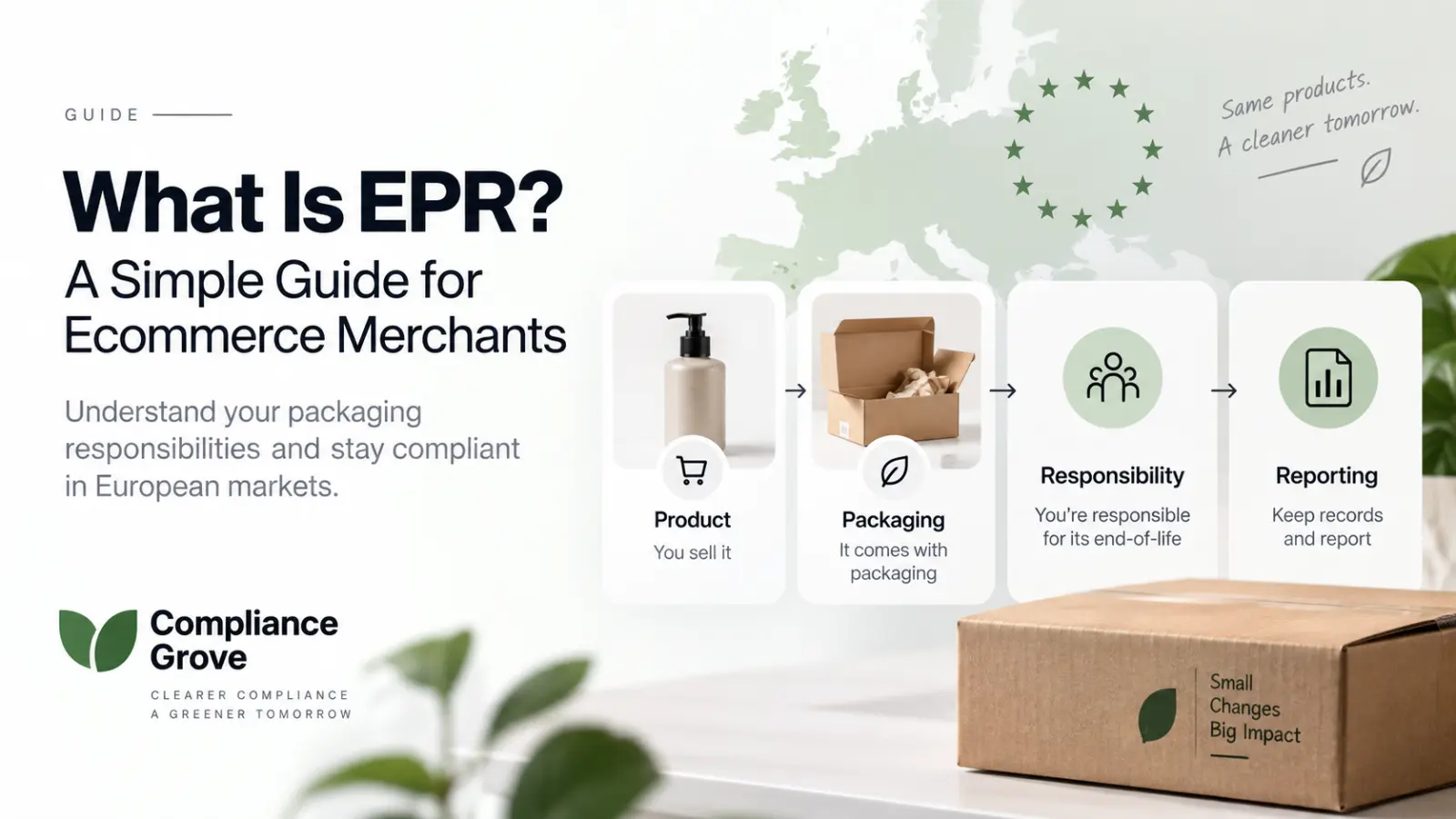
EPR
What Is EPR? A Simple Guide for Ecommerce Merchants
Extended Producer Responsibility (EPR) can be confusing for ecommerce merchants selling in Europe. Learn what EPR means,...