
What Is EPR? A Simple Guide for Ecommerce Merchants
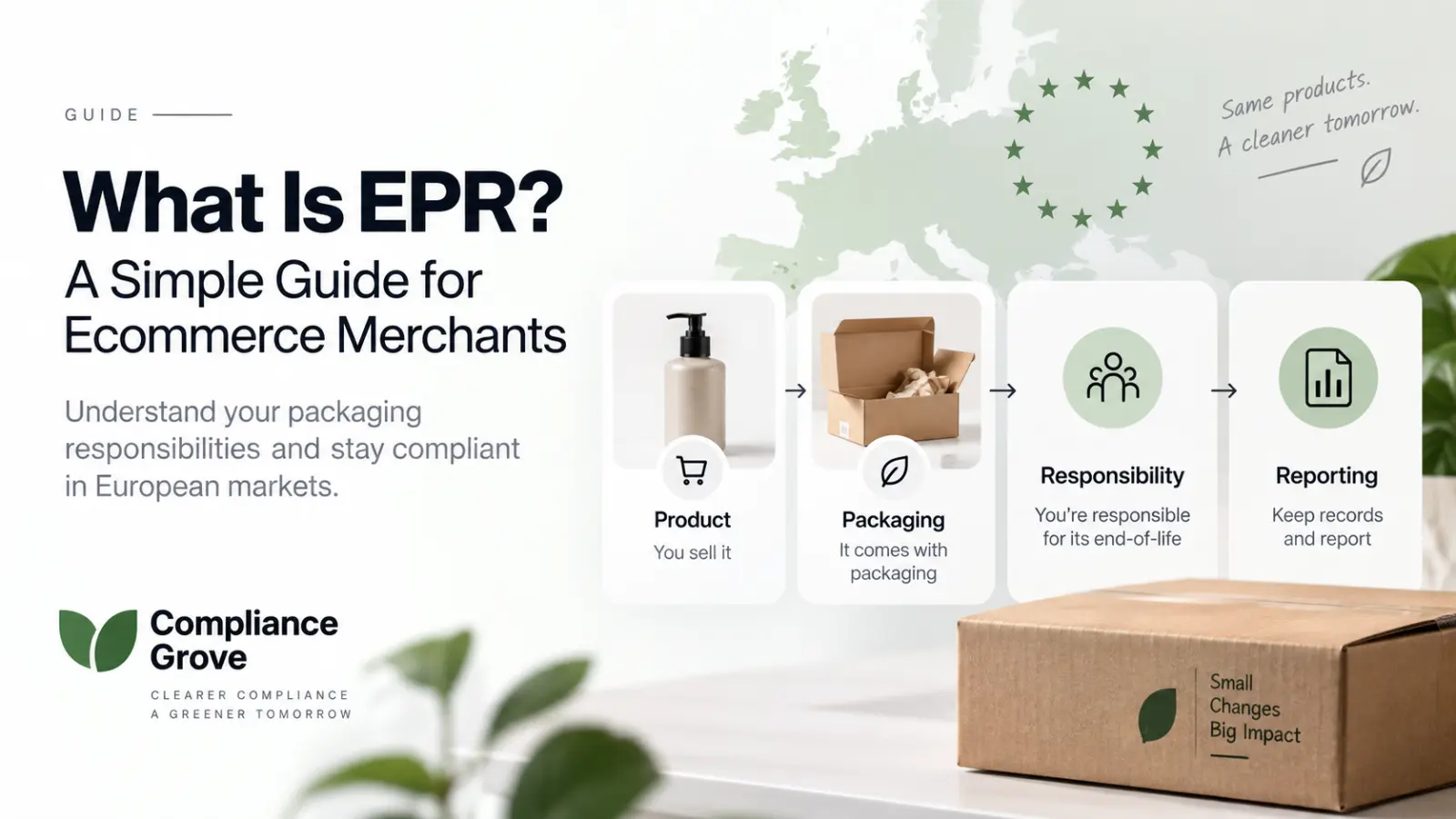
Extended Producer Responsibility (EPR) makes producers responsible for certain costs or organisational responsibilities associated with managing products and packaging at the waste stage of their lifecycle.
What Is EPR? A Simple Guide for Ecommerce Merchants
If you sell products in Europe, you may have come across the term EPR, or Extended Producer Responsibility.
EPR can sound complicated at first, especially when you're dealing with multiple European markets, different registration systems, packaging materials, reporting requirements, and waste-management obligations.
But the basic idea is straightforward:
EPR makes producers responsible for certain costs or organisational responsibilities associated with managing products and packaging when they reach the waste stage of their lifecycle.
For ecommerce merchants, understanding EPR starts with knowing what you sell, what packaging comes with those products, and where you place those products on the market.
Important: This article is for general educational purposes and is not legal advice. EPR obligations can vary depending on your products, packaging, business model, role in the supply chain, and the countries where you sell.
What Does EPR Stand For?
EPR stands for Extended Producer Responsibility.
Under the EU's waste framework, EPR means that producers can have financial responsibility, or financial and organisational responsibility, for managing products at the waste stage of their lifecycle.
The idea is to make the producer's responsibility extend beyond simply manufacturing or selling a product.
Instead, responsibility can continue into what happens when the product or its packaging becomes waste.
How Does EPR Work?
At a high level, EPR connects three things:
Product → Producer → Waste Management
When a business places products or packaging on a market where EPR rules apply, it may have responsibilities related to the waste generated by those products.
Depending on the applicable rules, this can involve activities such as:
- Registering with a relevant national system
- Reporting quantities placed on the market
- Paying applicable EPR contributions
- Working with a producer responsibility organisation or scheme
- Maintaining records and supporting documentation
The exact requirements depend on the product category and the country involved.
Why Does EPR Matter for Ecommerce?
For a traditional local business, understanding its market and packaging flow may be relatively straightforward.
For ecommerce merchants, things can become more complicated.
A Shopify store can sell products to customers across several European countries without having a physical store in each country.
That means a merchant may need to understand:
- Where products are being sold
- Where products are being made available
- What packaging is being used
- Which materials are involved
- How much packaging is placed on the market
- Which EPR requirements apply
- What registration or reporting obligations exist
The European Commission notes that EPR implementation can have territorial dimensions, with requirements differing between Member States.
EPR for Packaging
Packaging is one of the most important EPR areas for ecommerce businesses.
Think about a typical online order.
A customer might receive:
- A cardboard shipping box
- Paper filling material
- A product box
- A plastic pouch
- A product label
- Protective packaging
All of these components can contribute to the packaging footprint associated with an order.
For a merchant, the first practical step is therefore understanding what packaging is being placed on the market.
Why Packaging Data Matters
Good packaging data makes it easier to understand and manage compliance requirements.
For each packaging component, a merchant may want to keep information such as:
| Information | Example |
|---|---|
| Product | Product A |
| Packaging component | Shipping box |
| Material | Cardboard |
| Weight | 120 g |
| Packaging type | Transport packaging |
| Quantity | 1 per shipment |
| Market | Germany |
The exact information required depends on the applicable national rules and reporting system.
The important point is that you cannot effectively manage packaging compliance if you do not know what packaging you are using.
EPR Is Not One EU-Wide Registration
One common misunderstanding is that EPR is a single EU registration.
It isn't.
EPR requirements can involve national systems and different rules depending on the Member State and product category.
The European Commission has highlighted that EPR obligations can be connected to the territory of individual Member States where products are made available.
This means that a merchant selling across Europe may need to look at requirements on a country-by-country basis.
What Is a Producer?
The term producer does not necessarily mean the company that physically manufactures a product.
In EPR legislation, the responsible economic operator can depend on factors such as:
- Where the business is established
- How the product is supplied
- Whether the business imports products
- Whether products are sold through distance or online channels
- The specific product category
- The national rules that apply
For packaging, the PPWR establishes EPR responsibilities for producers in relation to packaging they make available for the first time on the territory of a Member State, subject to the regulation's specific rules.
That is why merchants should not assume that simply being an online retailer means they are either automatically responsible or automatically exempt.
EPR and Online Selling
Online commerce makes EPR particularly relevant because products can reach customers in countries where the merchant has no physical presence.
The PPWR includes specific provisions concerning producers offering packaging or packaged products to consumers in the EU through distance contracts.
For certain online platforms, the regulation also introduces information requirements relating to producer registration and EPR compliance before producers can use the platform to offer relevant packaging or packaged products.
This makes it increasingly important for ecommerce businesses to understand where they are placing packaged products on the market.
What About EPR Fees?
EPR schemes can involve financial contributions from producers.
These contributions are connected to the costs associated with managing waste and can be structured according to the applicable scheme and national rules.
The amount a business may pay can depend on factors such as:
- Packaging material
- Packaging weight
- Packaging quantity
- Product category
- Country
- Applicable EPR scheme
- Other national requirements
Some systems may also use environmental criteria when determining contributions.
Because EPR fees and calculation methods can change, merchants should check the current requirements of the relevant national system rather than relying on a generic EU-wide fee calculation.
EPR vs. Packaging Compliance
EPR is one part of the broader packaging compliance picture.
A merchant may need to consider several different areas at the same time:
EPR
Responsibilities associated with managing packaging waste and applicable producer contributions.
Packaging Data
Information about packaging materials, components, weights and quantities.
Registration
Registration with relevant national systems where required.
Reporting
Providing packaging quantities or other information to the relevant authorities or schemes.
Labelling
Certain markets and packaging types may have specific labelling or information requirements.
PPWR
Broader EU packaging requirements covering areas such as packaging sustainability, recyclability, reuse, waste prevention and labelling.
The PPWR began applying across the EU on 12 August 2026, creating a more harmonised framework for packaging and packaging waste while some requirements apply according to specific timelines.
A Simple EPR Example
Imagine you operate a Shopify store selling skincare products.
You sell to customers in Germany, France and Italy.
Each product is shipped using:
- A cardboard shipping box
- Paper protective material
- A printed product box
- A plastic component
Instead of looking at the order simply as:
"One product sold."
You can think about it as:
Product → Packaging components → Materials → Weight → Market → Applicable obligations
You can then organize the relevant packaging information and use it to determine which compliance processes apply.
What Should Shopify Merchants Do?
If you are selling packaged products in Europe, a practical starting point is to build a structured packaging data process.
1. Identify Your Packaging
List the packaging components associated with your products.
2. Identify the Materials
Record the material used for each packaging component.
Examples include:
- Paper
- Cardboard
- Plastic
- Glass
- Aluminium
- Wood
3. Record Packaging Weight
Keep track of the weight of each relevant packaging component.
4. Map Packaging to Products
Connect packaging information to the Shopify products or SKUs that use it.
5. Identify Your Markets
Understand which European countries you sell into and where your products are being made available.
6. Check Applicable EPR Requirements
Review the requirements that apply to your business, product category and target markets.
7. Keep Your Data Updated
Packaging can change when you:
- Launch a new product
- Change suppliers
- Change packaging materials
- Change packaging sizes
- Expand into another market
Your compliance data should change with it.
Common EPR Mistakes Ecommerce Merchants Make
Treating EPR as a One-Time Task
EPR compliance is not necessarily something you register for once and forget.
Your products, packaging, markets and reporting data can change over time.
Not Tracking Packaging Components
Knowing that a product comes in "a box" is often not enough for detailed packaging management.
You need a clearer picture of the materials and quantities involved.
Using One Spreadsheet for Everything
As your catalogue and markets grow, a single spreadsheet can become difficult to maintain and keep consistent.
Assuming Every EU Country Has the Same Process
EPR implementation can involve country-specific systems and requirements.
Waiting Until Reporting Time to Collect Data
Trying to reconstruct packaging data when a reporting deadline arrives can be much harder than maintaining it continuously.
How PackPilot EPR Helps
Managing packaging data manually can become difficult as your Shopify catalogue grows.
PackPilot EPR is designed to help Shopify merchants organize their packaging compliance information in one place.
You can use it to manage information such as:
- Products and SKUs
- Packaging components
- Materials
- Packaging weights
- Recyclability information
- Country-specific compliance information
- EPR registrations and requirements
- Reporting-related data
Instead of keeping packaging information scattered across spreadsheets and documents, you can build a structured source of packaging compliance data connected to your Shopify catalogue.
EPR Compliance Checklist
If you sell packaged products in Europe, start with these questions:
- Do I know which products require packaging compliance?
- Do I know which packaging components are used?
- Do I know the materials used in my packaging?
- Do I have accurate packaging weights?
- Have I identified the European countries where I sell?
- Have I checked which EPR requirements apply?
- Do I know whether registration is required?
- Do I have a process for maintaining packaging data?
- Can I access the information needed for reporting?
- Do I review my packaging data when products or packaging change?
If several of these questions are difficult to answer, your first step should be organizing your packaging data.
The Bottom Line
EPR extends producer responsibility into the waste stage of a product's lifecycle and can create financial or organisational responsibilities for businesses.
For ecommerce merchants, packaging is an important part of that equation.
The practical foundation is simple:
Know your products.
Know your packaging.
Know your materials.
Know your markets.
Understand the requirements that apply.
As your Shopify store expands into more European markets, having structured packaging data can make it easier to understand and manage the compliance processes that apply to your business.
Official Resources
For the latest regulatory information, consult official EU sources:
- European Commission — Waste Framework Directive
- European Commission — Packaging and Packaging Waste
- EUR-Lex — Regulation (EU) 2025/40
- European Commission — New EU Packaging Rules
Regulatory requirements can vary according to your business model, products, packaging, role in the supply chain and target markets. Always verify the requirements applicable to your specific situation.
PackPilot EPR helps with this.
Simplify EPR compliance and manage packaging data across Europe.
Stay up to date
Get new country compliance profiles and guides in your inbox.
Related Posts
EPR
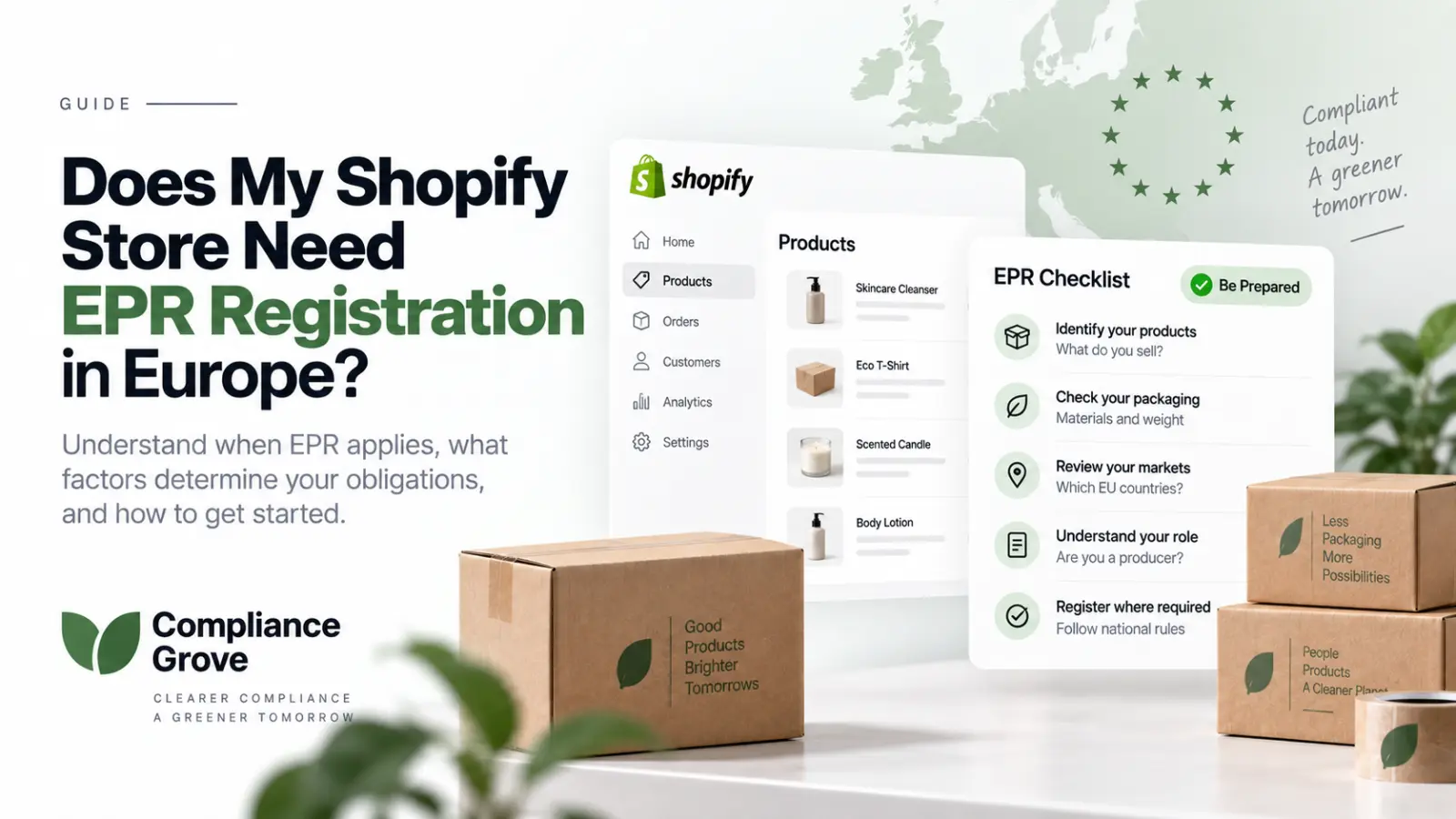
Does My Shopify Store Need EPR Registration in Europe?
Selling products in Europe? Learn when Shopify merchants may need EPR registration, what factors determine their obligat...